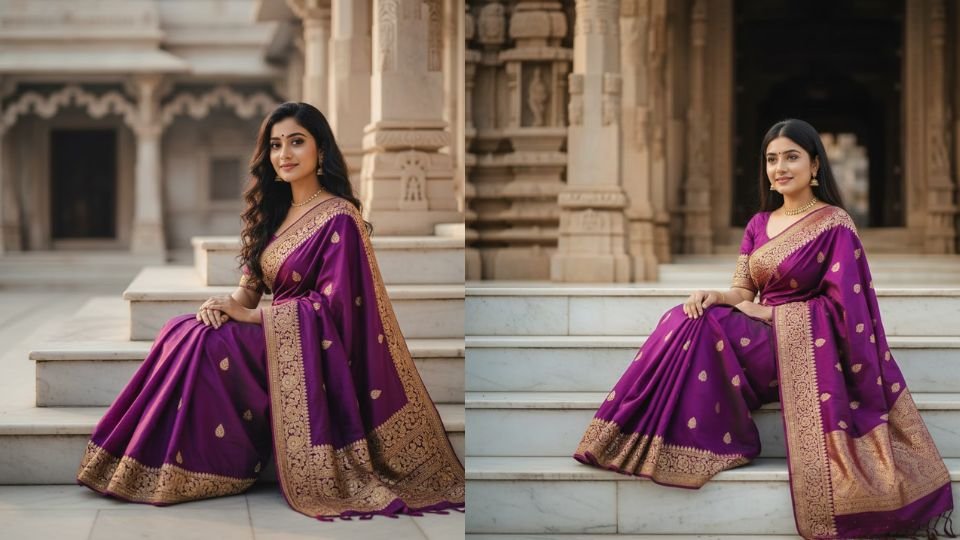
Creating a visually rich, cultural, and cinematic portrait in Gemini depends largely on how clearly you describe the subject, attire, location, mood, and visual quality. Gemini is very responsive to prompts that balance cultural detail with photography-style instructions. The given prompt is a strong example of how to achieve an elegant and realistic result when used correctly.
The first step in generating this image in Gemini is to clearly define the main subject. In this case, the subject is a beautiful young Assamese woman. Mentioning her regional identity is important because it helps Gemini understand facial features, attire style, and cultural context. Words like “beautiful,” “young,” and “graceful” guide the overall tone of the portrait without making it exaggerated.
Next, the pose and posture must be clearly stated. Describing the woman as “sitting gracefully on the marble steps” immediately sets a calm, composed, and elegant body language. Gemini often struggles with vague poses, so specifying sitting posture and grace helps maintain realism and avoids awkward positioning.
The location plays a crucial role in the image. A “traditional temple courtyard” with marble steps gives a strong sense of heritage and serenity. Gemini responds well to culturally rich locations, especially when they are described with architectural elements like marble, courtyards, or temple surroundings. This ensures the background looks authentic and not generic.
Clothing details are one of the most important parts of this prompt. The Mekhela Chador is a traditional Assamese outfit, and describing it in detail helps Gemini generate it accurately. Words like “vibrant deep purple,” “intricate golden zari embroidery,” and “matching blouse” clearly define the color palette, texture, and craftsmanship. This level of detail prevents Gemini from simplifying or misrepresenting the attire.
Hair, jewelry, and expression further refine the portrait. Mentioning “long, dark flowing hair” gives natural movement and softness to the image. “Minimal elegant jewelry” avoids over-decoration and keeps the look refined. A “soft smile” adds warmth and emotional connection, which is essential for portrait photography.
To achieve a professional result, visual quality cues such as “high-quality” and “cinematic portrait” are extremely important. These terms guide Gemini toward realistic lighting, shallow depth of field, and a polished photographic look rather than an illustration. You can also add optional phrases like “natural sunlight,” “soft shadows,” or “photorealistic” if you want even more realism.
Below is the exact prompt you should paste into Gemini to generate this image:
Prompt:
“Create a high-quality, cinematic portrait of a beautiful young Assamese woman sitting gracefully on the marble steps of a traditional temple courtyard. She is wearing a vibrant deep purple Mekhela Chador with intricate golden zari embroidery and a matching blouse. She has long, dark flowing hair, minimal elegant jewelry, and a soft smile.”
When using this prompt in Gemini, paste it as a single block of text. Avoid adding unrelated instructions or emojis. If Gemini produces a square image and you prefer a vertical or horizontal frame, you can add a final line such as “portrait orientation, 9:16” or “cinematic vertical framing.”
If the first result is not perfect, make small refinements rather than rewriting the entire prompt. Strengthening words like “ultra-realistic,” “natural lighting,” or “DSLR-style photography” can improve the output while preserving the original intent.
By combining cultural clarity, precise attire description, and cinematic photography cues, this prompt allows Gemini to generate an elegant, respectful, and visually stunning portrait rooted in Assamese tradition.
Leave a Reply